
Per Capita Davis: Scientists got it mostly right
The article on the front page of the New York Times was headlined, “The Year Global Warming Turned Model Into Menace.” The article itself basically says that predictions scientists have been making for decades based on computer models have now been proven correct. The planet is heating up, we are seeing more and longer droughts and heat waves and sea level is rising. We don’t need predictions from computer models to describe what we are now experiencing.
It may be picky of me to point out one not-so-small disagreement with the “they got it right” statement. Many of the past predictions for increased heat effects focused on the far future — mid-century or 2100.
According to a Stanford University climate scientist, “Decades ago when the science on climate issues was first accumulating, the impacts could be seen as an issue for others, future generations or perhaps communities already struggling.” But, as the science of Extreme Weather Attribution has advanced, so that the effect of a hotter climate on specific weather events can be calibrated, “It is now rote science to pinpoint how the heat-trapping gases have cranked up the risks. It’s a shift we are all living together.”
In other words, the future is here and now. The adverse effects of a warmer planet are not something just for our grandchildren or our children, it is for us. Or, as a NASA scientist describes the climate crisis and its effects around the world, “It’s not a wake up call anymore. It’s absolutely happening to millions of people around the world.”
Moreover, scientists caution that the droughts, heat waves and other extreme weather events do not represent a “new normal.” Although a UCLA scientist points out that current conditions vindicate scientists who have been predicting extreme weather as a result of increased global temperatures, he also states that, “We are living in a world that is not just warmer than it used to be. We haven’t reached a new normal. This is not a plateau.” Some are arguing that what we now refer to as extreme heat events will in the future just be called “summer.”
The article points out that 2016 was the hottest year on record in terms of global temperature, followed by 2017 and 2018 is on track to be the fourth highest. In terms of trends, 17 of the 18 highest global average annual temperatures have been since the year 2001. Not coincidentally, the amount of carbon dioxide in the atmosphere in 2017 was the highest in 800,000 years.
One of the most alarming “we got it right” predictions that turns out to be taking place faster than previously thought has to do with the Arctic. NOAA scientists indicate that the Arctic is warming twice as fast as any place on Earth, and coupled with rapidly melting sea ice, has required them to alter their prediction of when we would see ice-free summers from 40 years from now down to 20, contributing to more and longer extreme weather events in the lower latitudes. Temperatures in the Arctic in February spiked to an average of 27 degrees above “seasonal norms.”
Also according to the article, increased annual temperatures are having adverse effects around the globe. For example: sea level rose approximately 3 inches above 1993 levels in 2017, increasing the risk of coastal flooding; the average temperature in the United States between last May and July was the highest ever and about 5 percent above historical numbers; nuclear power plants have been shut down in Europe because the temperature of river water used to cool the reactors was too high; and extreme heat on four continents was so severe that it crashed the electrical grid, in part due to increased use of air conditioners.
On a more visceral level, mortality statistics attributable to adverse heat events are increasing around the globe, including a projected five-fold increase in the U.S. and 12 times more deaths in the Philippines. Several recent articles have documented widespread suffering in India, Bangladesh, and numerous South Asian and African countries as temperatures skyrocket and no way of escaping the heat.
Pretty gloomy stuff, but the article goes further, stating scientists have concluded that, “Temperatures are still rising, and, so far, efforts to tame the heat have failed. Heat waves are bound to grow more intense and more frequent as emissions rise. On the horizon is a future of cascading system failures threatening basic necessities like food supply and electricity.”
In terms of our immediate area, scientists have made a connection between increased heat and the occurrence, duration and severity of wildfires. Though not the only factor involved, the climate crisis is a strong contributor. Warmer temperatures and longer droughts result in “fuel-loading,” increasing the amount of flammable material.
But, discussion of the connection between climate change and fires is for another column. Suffice it for now that many of the predictions made by scientists in past decades have had to be re-evaluated as adverse effects are developing more quickly than anticipated while actions by nations to reduce emissions are plodding along slower than needed.
— John Mott-Smith is a resident of Davis. This column appears the first and third Wednesday of each month. Please send comments to johnmottsmith@comcast.net.
Crossposted from the Davis Enterprise
Published online August 15, 2018
Printed August 15, 2018 edition page A8
Follow Us




FACEBOOK FEED
🎃 No tricks, just energy-saving tips!
Join Cool Davis this Sunday for a FREE Home Energy Workshop and Electric Home Tours. Discover how electric home upgrades can help reduce energy use and lower utility bills!
Register here:
www.cooldavis.org/home-energy-tour-2026/

0 CommentsComment on Facebook
Join Cool Davis for a free Home Energy Workshop and Electric Home Tours on November 1st!
Registration required. Visit cooldavis.org/home-energy-tour-2026/ to learn more.
#cooldavis #davisca #energyefficiency #CleanEnergy

0 CommentsComment on Facebook
TWITTER FEED


🎃 No tricks, just energy-saving tips!
Join Cool Davis this Sunday for a FREE Home Energy Workshop and Electric Home Tours. Discover how electric home upgrades can help reduce energy use and lower utility bills!
Register here:
https://www.cooldavis.org/home-energy-tour-2026/

Join Cool Davis for a free Home Energy Workshop and Electric Home Tours on November 1st!
Registration required. Visit https://www.cooldavis.org/home-energy-tour-2026/ to learn more.
#CoolDavis #DavisCA #EnergyEfficiency #CleanEnergy

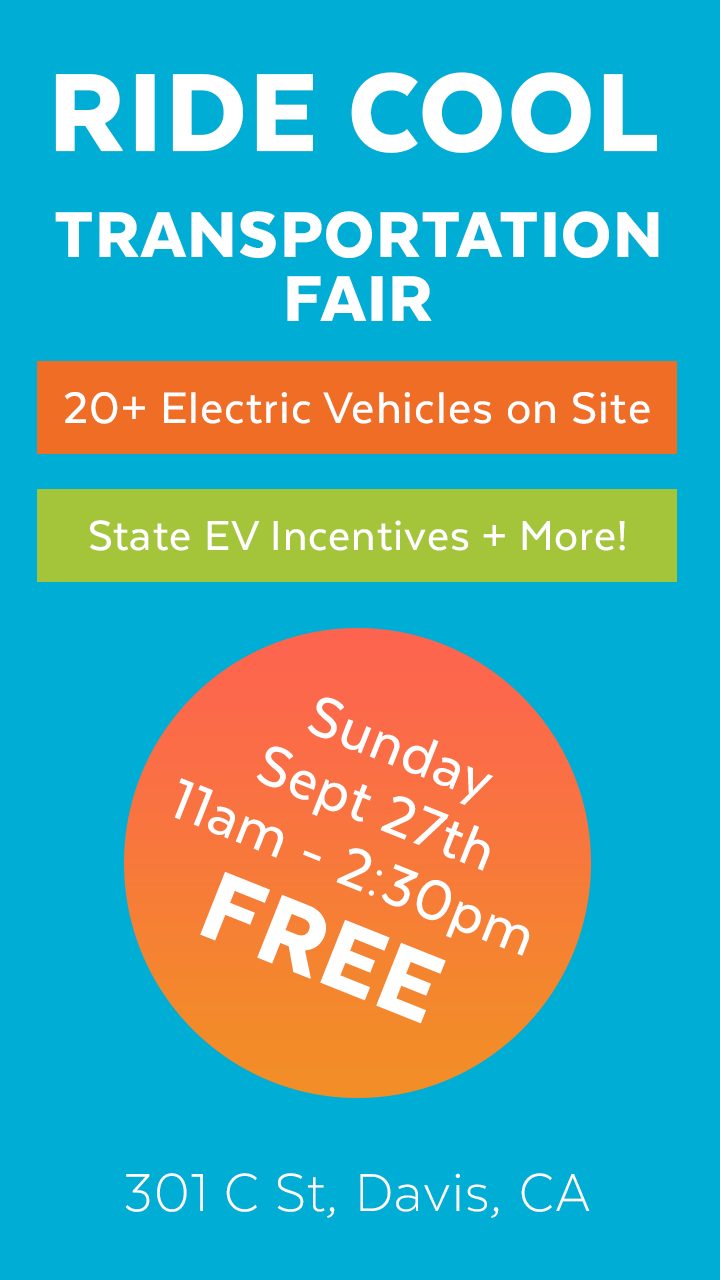
Curious about EVs? E-bikes? Want to learn about them without the sales pitch? Then come this Sunday to talk directly to owners and check out all the green transportation options in #Davis and #Yolo
Don't freak out, there's still time! Please give to help us meet our goal by midnight! #yoloca #bdog2024 #givebig2024 #nightowls https://www.bigdayofgiving.org/cooldavis
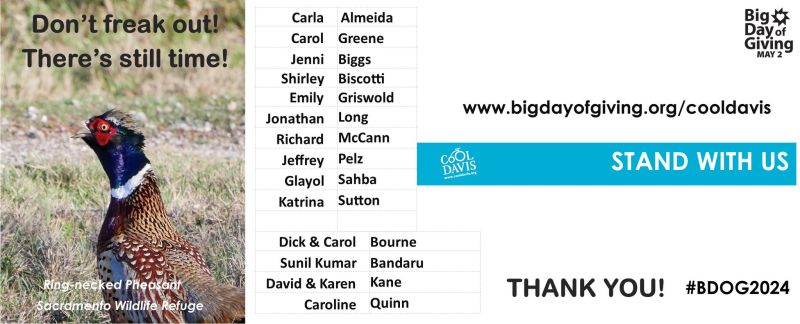
Thank you for helping us fly free with your evening donations (not easy in the dark ;) #yoloca #bdog2024 #givebig2024 https://www.bigdayofgiving.org/cooldavis